Ensuring fire safety in commercial, educational, healthcare, or residential buildings involves more than choosing furniture for comfort or style. Upholstered seating and mattresses play a critical role in preventing fire hazards. If you are an employer, landlord, facilities manager, or premises controller, you are legally designated as the Responsible Person and must ensure all furniture and mattresses meet relevant fire-retardant standards (BSI Group, 2007; NHS England, 2021).
Non-domestic furniture must meet higher fire resistance requirements than domestic furniture, based on the environment and risk level. The main UK standards are:
These standards help determine the appropriate level of flame retardancy based on the expected fire risk in each environment.
Furniture and mattresses are tested to BS 5852 commonly referred to as a Crib test when tested to higher levels. This test simulates small, controlled fires. The crib is a small stack of wooden sticks arranged in a neat column. Different crib tests, such as Source 0, 1, 5, and 7, use varying sizes and arrangements of wood to represent increasing fire intensity. Testing evaluates:
The result is a crib rating or hazard classification, which indicates the level of fire exposure the furniture can safely withstand, informing which environments the furniture can safely be used in.
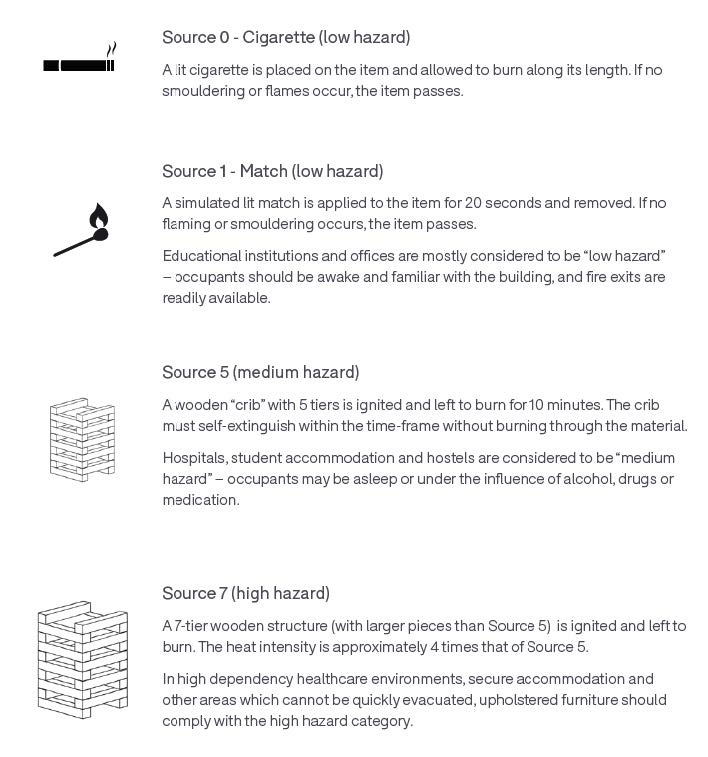
Standards classify furniture and mattresses according to hazard categories, based on occupancy, evacuation difficulty, and fire risk:
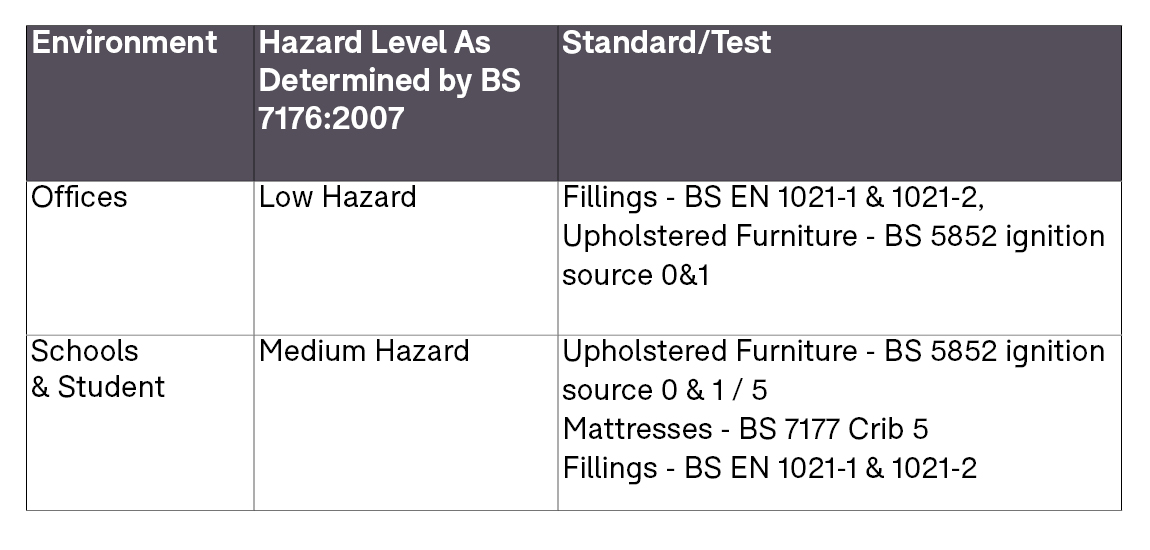
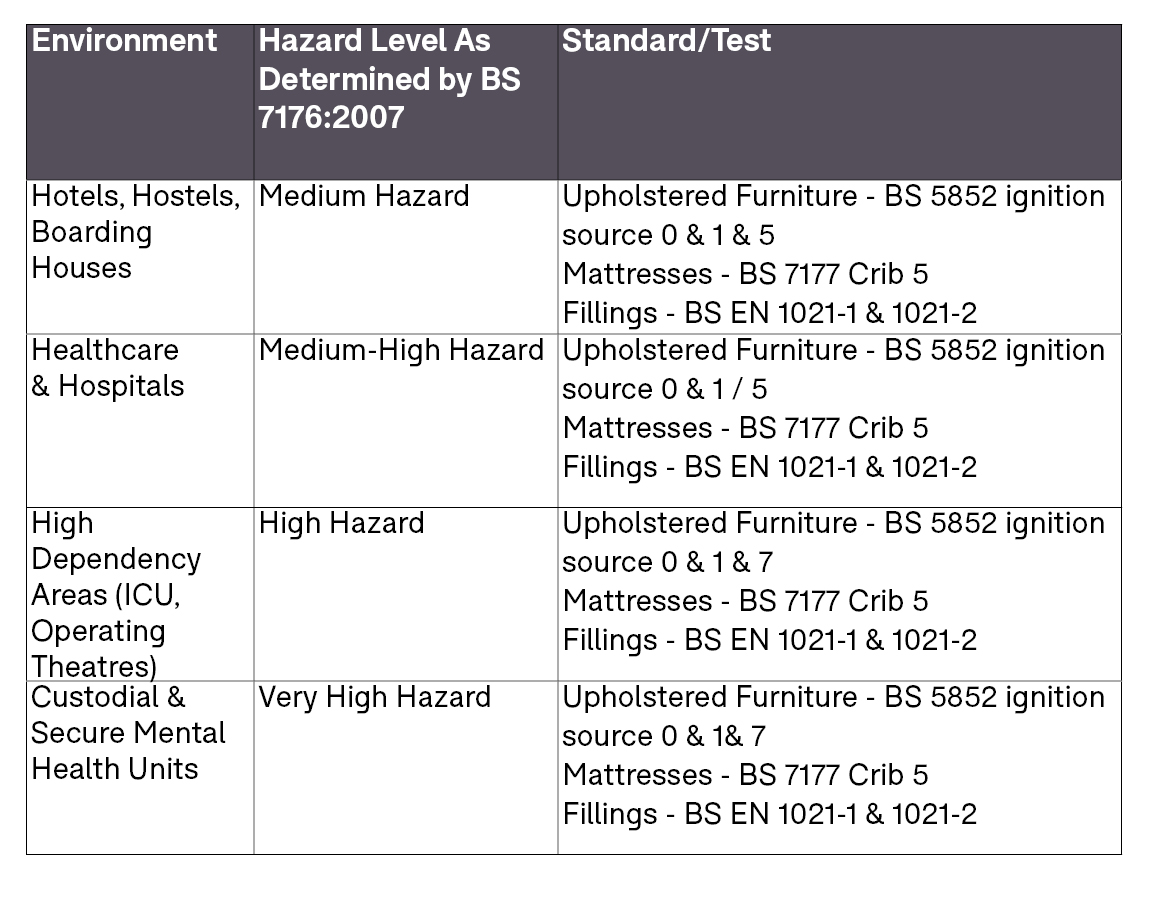
Furniture used in high-risk areas must be robust, flame-resistant, to protect occupants who cannot evacuate quickly. In some cases it may be necessary for furniture items to be Reduced ligature or tamper resistant. It is the responsibility of the architect or premises controller to determine which features are required for their specific environment.
Fire safety is an ongoing responsibility. Risk assessments should be reviewed regularly, particularly when:
Regular reviews ensure compliance with legal standards and help prevent injuries or fatalities in the event of a fire (NHS England, 2021).
Remember: Fire safety is an ongoing process – Review, Revise, and Monitor.
Please note that wall panels, padded wall products and acoustic tiles are subject to separate fire safety standards not listed here and should be carefully assessed for their intended environment.
For environments where safety, durability and ease of maintenance are essential, the Ryno® range offers a robust solution. Designed for challenging settings, Ryno® products are fire retardant and tested to recognised flammability standards, including BS 5852:2006 Ignition Source 5 (Crib 5), helping support safer specification across demanding environments.
You can discover the Ryno® range here.
Selecting the right furniture and fabrics for your environment doesn’t have to be complicated, our expert team are on hand to answer your questions.
📩 [email protected]
📞 +44 (0)1622 237830
BSI Group (2006) BS 5852:2006 – Methods of test for assessment of the ignitability of upholstered seating by smouldering and flaming ignition sources. London: British Standards Institution.
BSI Group (2007) BS 7176:2007+A1:2011 – Specification for resistance to ignition of upholstered furniture for non-domestic seating by testing composites. London: British Standards Institution.
BSI Group (2008) BS 7177:2008+A1:2011 – Specification for resistance to ignition of mattresses, divans and bed bases. London: British Standards Institution.
NHS England (2021) Health Technical Memorandum (HTM) 05-03 – Fire safety: Operational provisions – Part C: Textiles and furnishings. London: NHS England. Available at: https://www.england.nhs.uk/rightcare/wp-content/uploads/2021/05/HTM_05-03_Part_C.pdf [Accessed 6 Jan 2026].

